
A Conversation with Li Ren, President of AIA Middle East and Associate of Perkins Eastman in Dubai

Li talks about collaboration, innovation and curiosity – the things architects need right now from their supplier partners in the region.
The Middle East market is booming - but maturing
Traditionally fuelled by oil wealth, the Middle East continues to develop some of the world’s most impressive cityscapes out of its desert landscape. No other place on earth has seen anything like the scale, ambition, and seemingly relentless pace of development this region has experienced over the past 20-30 years. Looking out over the skylines of headline hotspots such as Dubai, Abu Dhabi, Qatar and Saudi Arabia from the top of any one of their record-breaking skyscrapers, reveals a buzzing, burgeoning futurescape that did not exist just a couple of decades ago.
But things are changing. Facing up more squarely to environmental responsibilities, there is a growing focus from developers on adopting more sustainable practices and responding to the unique cultural landscape which they are presuming to reshape. From the outside, the region continues to be highly dynamic, but behind the headline projects, there is a shift from bigger and bolder to smarter, more thoughtful development.
It is in the context of these more considered, value-driven collaborations between architects, developers and suppliers that BOND asks Li about the factors currently shaping the design trends in the region.
Originally from China, Li was educated in the U.S. and practiced there before coming to Dubai three years ago. His global perspective, AIA standing, and experience of navigating high-profile projects throughout the Middle East, means he has unique and invaluable regional insight for architects and suppliers trying to establish themselves in this uniquely challenging marketplace.
“Three years ago, you could build anything and make money. Now the land is expensive, the costs are high — developers are rethinking everything.”
Li: The Middle East is definitely a booming market, compared to other parts of the world but it’s unique in many other ways: First, the population here is not that much. And, education, especially higher education, is a little bit out of date. So, most of the high-profile projects, the large-scale construction, design and consulting work is being run by the expats. So, when I’m working on a big project in the UAE or Saudi, the whole office is expats, except maybe the supervisor or manager who may be Saudi or Emirati.
Despite the recent development boom, the region’s limited population and outdated higher education means major construction, design, and consulting projects are largely managed and executed by expatriates.
Global ambition meets local identity
Even though much of its built environment is designed by expats, cultural relevance remains non-negotiable:
“Most major projects are designed and executed by expats — but the local stakeholders want something that reflects who they are…They don’t want another Shanghai or London. They want something authentic.”
Li: The Middle East has unique cultural context because on one side, they have huge ambition to become the next modern countries, to build the next modern cities, but they also have a huge concern about their own cultural heritage. But, because they can lack understanding of modern design, they rely on outsiders like me to hire the best experts to do our work. And, at the same time, they want to build a truly unique city that reflects where we are, rather than just duplicate another London or Shanghai in the Middle East.
So, there is a cultural duality to consider – balancing strong ambitions for modernization with an appropriate respect for a unique and ancient cultural heritage. There is also a clear dependency on external expertise, due to limited understanding of modern design but a desire for authentic identity shines through.
No more blind investment
A more competitive market with spiralling costs is making developers adopt a more considered approach:
“There’s a move from ambition alone to more strategic execution — owners want efficiency, value, and identity.”
Li: Three years ago, the market just kept booming. And a lot of developers were making money without open eyes, right? Buying every block and building they could get. But now they are being very careful to manage their projects in the right ways because the land is expensive now. Secondly, it's so competitive, and the construction costs are so high.
I heard that a lot of the developers are losing money now. So, they are trying to rethink their situation. And the local owners are reconsidering their business models to make sure their project is efficient and gives maximum returns to their investors.
The real estate market here has moved from a booming, easy-profit phase to one requiring careful management.
Architects need suppliers to step up as creative partners
“On some projects, the supplier is leading the innovation - not the architect. We rely on suppliers to educate us. They know their materials best. Sometimes they open up new ideas we hadn’t considered.”
Li: For each product, I need to provide 3 vendors, right? And at least one provider needs to be a local supplier - they don't want three names from all over the world - this just makes their job harder to do.
Secondly, we are starting to rely on suppliers more to teach us how to use the materials wisely and what the possibilities are. For example, I have a new project on the Palm View – it’s a viewing deck, which would usually be just a glazed wall so we can see the views. But the manufacturer has proposed a cantilever and glass box system so you can lie down in there.
These new approaches are scary for us architects – there’s a lot of hype around it and it’s great for Instagram or whatever but you’ve got to make it happen! And it’s the supplier who is leading this innovative approach, not the architect or contractor.
Suppliers who thrive at the leading edge of design in the Middle East are not just product vendors - they are driving innovation and helping solve design problems. They need to position themselves as enablers of design rather than just product pushers. Leading architects and designers in the region are increasingly valuing solutions and insight, not just spec sheets.
Educate first, then sell...
“Suppliers need to educate before they sell. Don’t just follow the old way - show how you developed the product, how it’s evolved. That’s what we want to learn.”
Li: More and more projects are like prototypes, where we have new steps A, B, C, D and need to get approval for each one. And from the supplier side, because they know how to exploit the features of the material, they can open up a whole new market rather than stick to the old way.
There’s a hunger for supplier knowledge - but it has to be relevant, contextual, and delivered as part of a real conversation.
Early engagement leads to better outcomes
“There’s no such thing as too early"
Li: It’s never too early. In fact, the earlier the better. As soon as I have your production or your design ideas in my office, we can brainstorm about what we can do next. And I’ll always encourage them to jump out of the box, right? Give up the traditional ways. And if it works, I’ll use it in my next projects, so we have a win-win solution.
But also, maybe I have another project that I can’t handle alone, but together we can handle it. And this is good for my business. If I have your idea in my mind at the concept stage, we can think together. Sometimes, it’s not just about using the product — it's about working together for a new solution.
The earlier a supplier engages with an architect, the more likely they are to shape the project — or even co-create something new.
Why forums Like Arc Middle East work

Why events like Arc Middle East create the kind of meaningful exchanges that traditional conferences can’t:
“At 95% of the events I attend, someone is talking on stage and everyone else is sitting on chairs, playing with their phones. But I’ve made real friends at your events - not just collected business cards.”
Mike: Are forums like Arc Middle East important for this cross-pollination of ideas and in increasing mutual understanding between architects and manufacturers?
Li: The Arc Middle East platform is still quite unique in this area. The speed-dating concept is different to 95% of the events I attend where someone is talking on stage and everyone else is sitting on chairs, playing with their phones. But with your platform, we talk to each other. And, in 15 minutes, you know if you want to continue the conversation and there’s time to do that.
I make a lot of friends at your events, but at other conferences, I just get a lot of business cards. It's about relationships, as you say, and it starts with that initial conversation.
The direct engagement format of Arc Middle East encourages genuine dialogue and connection. Short, focused conversations from the 1-on-1s help participants to quickly identify potentially valuable connections to follow up in the networking later.
(If you crave genuine dialogue and connection with the most Influential architects in the Middle East, please fill in the form and we will be in touch):
1-on-1 conversations bring fresh ideas
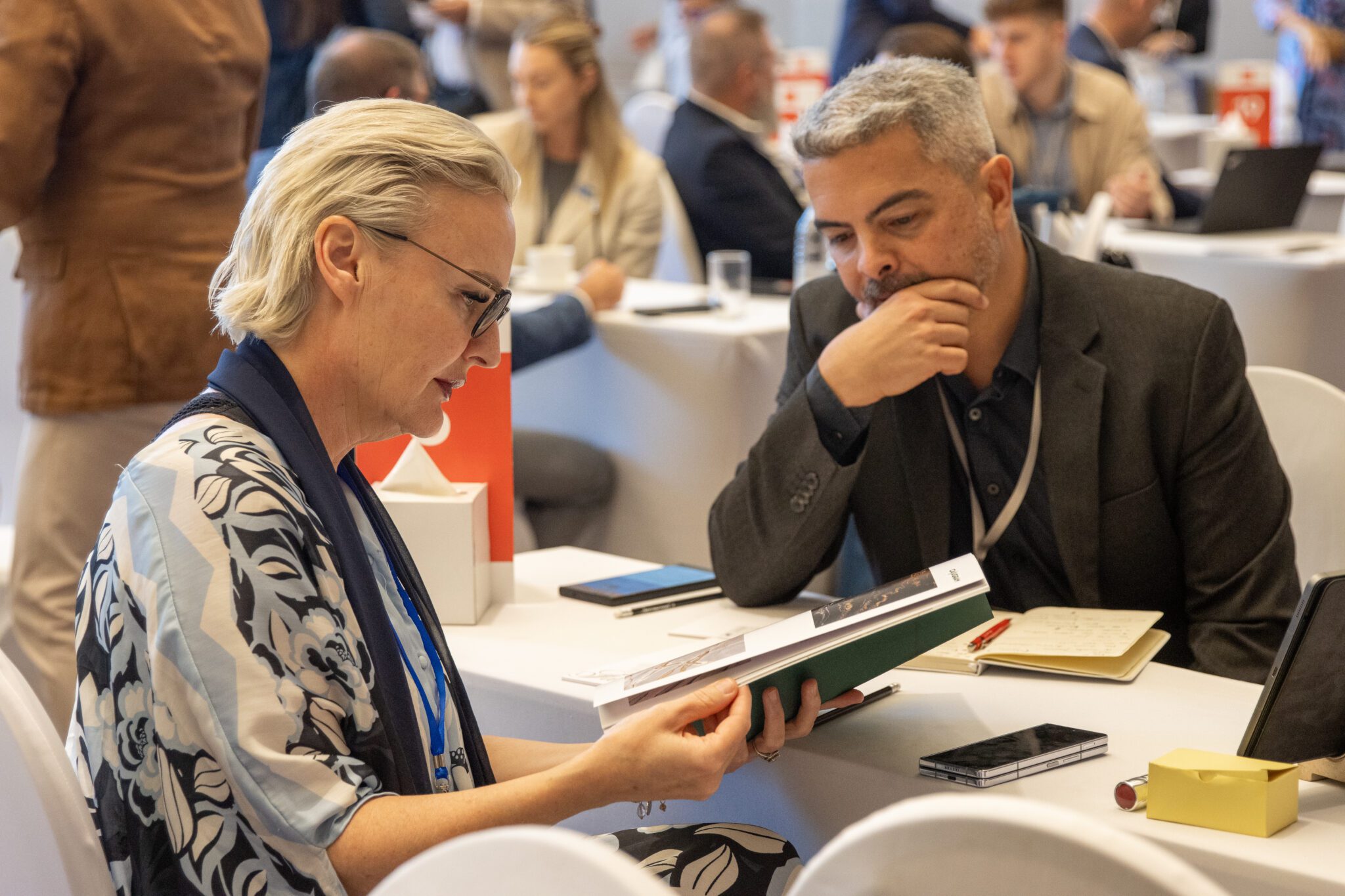
Lunch & Learns are useful, but not as impactful as informal, relationship-based learning:
“the 1-on-1 and continued conversations at your forum just seem to encourage fresh ideas and alternative solutions. Makes things more interesting”
Li: Comparing your way to traditional lunch & learns where suppliers come and showcase their products and leave a card, the 1-on-1 and continued conversations at your forum encourages fresh ideas, alternative solutions, and just makes things more interesting.
Interesting story – last year at Arc Middle East I was talking to a chair manufacturer. We were going through the textures and finishes in their brochure and this beautiful, man-made pattern jumped out. I have ended up using the pattern as a shadow box for a façade and it looks great! Just an example of coming up with new ideas there and then with the manufacturer.
Direct, personal conversations spark creativity and lead to innovative design solutions, making the 1-on-1 experiences at Forums like Arc Middle East more productive and inspiring than lunch & learns tend to be.
Openness creates new possibilities
"It inspired a lot of us architects and engineers to email them with questions and to start building connections there"
Li: I’m reminded of JOTUN – a paint manufacturer from Norway. They had around 100 of us at the factory showing us how they did things – more of an education than selling thing. And it inspired a lot of us architects and engineers to email them with questions and to start building connections there.
Great ideas don’t always come from where you expect. An open-door policy on both sides makes room for serendipity and creativity born out of shared dialogue.
The importance of storytelling

“Show us the whole picture of the whole process – who they are as a company, not just production. Why they do what they do”
Mike: So, you’re interested in the story of a product – not just what it does? I guess if a manufacturer is doing interesting things that they’re excited about and want to share, it’s bound to be educational and inspiring – that’s a manufacturer you want to go and see, right?
Li: Exactly. And that’s what I’m trying to highlight. At BOND you get that face-to-face conversation, and it’s a great start to working together. And the door is always open at my office for them because we already had a conversation. And I know them and they know me. And every time they visit they bring something new so I get greater insight. And I give them information about projects and the cross-pollination of ideas grows.
Mike: And, on the other side, are there common pitfalls that suppliers tend to fall into?
Li: Many manufacturers have so many things in their pocket but only show us one or two main products, following the traditional sales ways. It’s their job. But I think there are smarter ways - show us the whole picture of the whole process – who they are as a company, not just the products: why they do what they do – where the ideas come from. Much more educational and insightful.
We sit in our office all day, just focused on the drafting, bringing in products. But we might never know how the things get built. These stories make the whole thing more interesting and memorable for us.
Manufacturers who go beyond traditional sales pitches and showcase the full scope of their work and creative process make a more meaningful impact and help architects like Li to enjoy the whole design process more.
Understanding the end user’s needs
What works in the U.S. or Europe won’t necessarily work here. Context is everything:
“They need to understand the end user’s needs and priorities- respond to where they are and what matters to people here. To revise the story.”
Li: Sustainability is always most critical, but you can't just say you are sustainable, you need proof. And this brings us back to the company’s vision – their ethos. And they need to understand the end user’s needs and priorities.
For example, there’s a US lock manufacturer who sells on durability, affordability and security. But it’s super safe here! So maybe they should focus on making them more beautiful, with golden scales or something – respond to where they are and what matters to people here. To revise the story.
Sustainability claims must be backed by real proof, not just marketing statements - a company’s sustainability efforts should reflect its deeper vision and values. Brands need to adapt their messaging and products to suit the priorities and context of the local market.
Cultural context is everything
“My advice is to arrive one week earlier and walk around the area, have some conversation: understand people's lives first and then come to talk to us”
Li: When I meet manufacturers at your conference, sometimes it’s their first time in that area. My advice is to arrive one week earlier and walk around the area, have some conversations: understand people's lives first and then come to talk to us.
A lot of the conversations at BOND are like telling stories. So, I tell them about life here and they tell me about life in Europe and so we start to learn about each other and it makes the conversation so much more interesting than just talking projects and products. And these are the things you remember after the event – what you talked about. So, when they phone you up you’ll remember them.
It is inevitable and entirely right that understanding local cultural context should be key to a manufacturer’s success and spending time in the locale before an event like Arc Middle East is an excellent place to start.
The right regional insight is critical
“I think the best attitude is to be open and honest – tell me they’re thinking of bringing production out here and ask us about it – get the right insight from us directly. Your forum is perfect for that.”
Mike: So, do you think forums like Arc Middle East are helpful to suppliers who are looking for valuable regional insight and contacts if they're looking to move into the Middle East?
Li: Definitely. Your forum creates the scenario of encouraging the supplier to talk to the right person, right? Especially if it's the supplier's first time here, I think it's always important to have a right first impression about what the market looks like, and what we are looking for. I think the best attitude is to be open and honest – tell me they’re thinking of bringing production out here and ask us about it – get the right insight from us directly. Your forum is perfect for that.
There are a lot of things with face-to-face conversation that cannot be replaced by messaging on WhatsApp or LinkedIn. You have to sit down with a coffee or drink and make conversation that is unique and constructive. So, next time we meet here, they are more prepared - they see my side better and how things work out here.
Adaptability and listening are the real competitive advantages and success for suppliers here means understanding the environment — not assuming it's the same as elsewhere.
An open attitude is the most important thing to bring to any dialogue with architects of Li’s calibre such as you will meet at Arc Middle East. You know you’ll be speaking to the right person, and if you ask the right questions, you’ll get the most valuable takeaways
The Middle East as a cultural filter
“Hundreds of years ago, the Middle East was a trading region — East meets West. That’s still true today…You need to be ready to talk to everyone — Arabs, Chinese, Indians, Europeans. That’s the reality here.”
Mike: Big one to end on: Spanning back out to the global picture, how would you say global trends, tend to translate or filter into the Middle East market?
Li: Wow, that is a big one! Well, I am reminded of Hundreds of years ago, before we found oil in the Middle East, their business was trading. From East to West and West to East. Why is Emirates so successful? Because it’s in the middle, right? 7 hours to Shanghai, Tokyo or London. So, it’s the perfect meeting place. Not just for Arabics but for Chinese, Indians, Japanese. So, anyone could be your business partner here, with all the cultural influences they bring.
So, it is a natural global melting pot of cultures and ideas. And I see design trends starting to reflect that – and these are the sorts of conversations I like to have with suppliers – to escape the stereotypical expectations of design over here - to collaborate and come up with something new together..
Sitting between East and West, the Middle East is a natural hub for global trends to meet and evolve. That’s why cultural curiosity and flexibility are essential for suppliers who need to see this regional distinctiveness as an opportunity rather than a challenge.
Be Curious!
“Don’t be cynical. Be curious. That’s why we’re here.”
Li: Frankly speaking, sometimes I feel like us architect engineers, we sit in the office all day and we know quite little about the world outside. We just focus on the drafting. But we might never know how the thing actually gets built. So we need to get out of the office and talk to people and suppliers need to do the same.
Mike: I guess that brings us full circle back to how important it is to get out of the office and talk to people. How that can shift your expectations. Get out of your head and get creative rather than staying put and being cynical. It’s a harder thing to communicate about forums like Arc Middle East. We can tell you who’s going to be there but, naturally enough, people are still cynical. But, if their attitude is more one of openness and curiosity – to come and listen as well as talk. That’s where that cross-pollination of ideas brings more interesting possibilities for everyone. Be curious and let the possibilities open up in front of you! I think that’s an excellent note to end on.
Li: Exactly, Mike. Don’t be cynical. Be curious. That’s why we’re here.
Like any region, it takes time to understand and navigate business in the Middle East and to build the relationships you need to thrive here. It’s not about being perfect, it’s about being curious, open and not afraid to get amongst it and start asking questions.
Arc Middle East 2026 is happening on February 6-9, 2026 in Abu Dhabi. If you are a manufacturer who craves open, creative conversation with architects running the large-scale commercial projects in the region, we suggest you get in touch today.
