
Turn 30-minute meetings into 7-figure sales

Getting specified by big-name architects for high-profile projects takes more than dropping off a brochure or sending a few emails. Architects are short on time, so they love things that make it easy for them to make the right decisions for their clients. That means whatever helps them to deliver outstanding results - on time, on budget and with as little drama as possible. Manufacturers who help them to do that are destined to become trusted, long-term project partners. But you’ve got competition. Lots of it.
Over 21 years of talking and listening to some of the world’s most prolific and accomplished architects and designers, BOND has picked up a thing or two about what these project leaders are looking for in the ideal, long-term supplier partner. This article is your guide to what really matters to architects when choosing manufacturers to work with and how to position yourself as the go-to option when a need arises around your particular product.
What does getting specified by architects mean?
Having your product or system specified by an architect means that it has gone through an approval process and is now listed by that architect as required or recommended for use in a particular project.
Getting specified means that your product is now part of that project’s official design documents, directing and influencing what contractors will buy and install.
But, as any experienced architectural specialist will know, getting your product onto a project’s spec. sheet does not guarantee it will be used. This is where ‘onsite influencers’ come into play such as contractors reverting to tried and tested products and solutions in place of those listed by the architect.
But an architect with suitable seniority and influence is able to 'protect spec.' and they will often call on that manufacturer to guide a contractor on the benefits and correct installation of the new product. Furthermore, having now tried and tested this new product, the chances of it being used again by both architect and contractor are significantly higher.
Winning the favour and support of these top-level architects is the game-changer and here's how:
How do architects and specifiers choose materials and products?

Know your target
You need to understand what makes architects tick; what’s on their mind, how they work, what they value, where they go to discover new products and what their key influencers are.
Move from sales to problem solving
Ask yourself: what are the project challenges that your product (and your team of experts) can help architects overcome? If this question forms the basis of your marketing and communications to architects, your dialogue and relationship has already begun. If you can immediately address the questions and issues that an architect might face when selecting a product and make it easy for them to find the answers and support that they need, you have already established your credentials as a potential project partner.
Right place, right time
Developing your website as an indispensable resource for architects is one thing but they need to find it in the first place. This is not the place for exhaustive, technical SEO advice but being found in the right place at the right time online and seamlessly delivering what a time-pressured architect needs is worth its weight in gold. This is a process that takes time and investment and the right specialist support who will understand both your target and your own unique offering and bring them together through deft website development and content creation.
Developing your website architecture and content around an architect’s needs will make them feel at home: that they have come to the right place and don't need to go anywhere else.
Collaboration = Communication + Timing
Architects are tired of juggling countless materials and navigating confusing websites and walls of spreadsheets when sourcing products. And now, stricter energy codes, sustainability standards, and complex projects demand more transparency and deeper collaboration with manufacturers from the very start.
Architects need quick answers, visual product data, and flexible options. Manufacturers, in turn, are looking for earlier involvement, not only to provide technical insight but to share the journey of discovering new possibilities together. And these closer collaborations are informing the development of the design-assist services manufacturers are providing through their websites, streamlining the whole design and installation process.
AI-Powered Connections
A revolution in CAD and BIM software is reshaping the architect-manufacturer relationship, aiming to connect architects with the materials and manufacturers they need to enable fast, informed decisions that enhance both creativity and efficiency. BIM software even allows architects to produce datasets that facility management teams can use to project the efficiency of buildings before they’re built!
Make it Accessible
The information on your website and other marketing materials needs to be accessible to those less technically-minded than the architects themselves: an architect will often come to select products late in the project cycle when their back’s against the wall on deadline and cost and they don’t have time to get their head around a new product so they’ll task a junior to do it instead. Make it as simple as pie for that junior to find and understand the info. they need and you’ll make it to the top of their recommended list.
Timing is (almost) Everything

If you know, right now, that a firm has active projects that are right for your products, the right, timely approach could yield surprising results. Zoominfo, for example provides a stream of ‘market intelligence’ from news and social platforms on businesses, such as architecture firms that you may be targeting. Furthermore, platforms such as DataBid can give you a project heads up, giving you a window of opportunity to get a timely message across. Such tools can give you the power to show up when architects or their firm’s researchers are looking in search engines or on social platforms for the very thing that you are able to help with so offer that help as widely as you can.
Engage with the architects as early as possible
It’s never too early in the project cycle to engage with an architect:
"It’s never too early. In fact, the earlier the better. As soon as I have your production or your design ideas in my office, we can brainstorm about what we can do next. And I’ll always encourage them to jump out of the box, right? Give up the traditional ways. And if it works, I’ll use it in my next projects, so we have a win-win solution.
But also, maybe I have another project that I can’t handle alone, but together we can handle it. And this is good for my business. If I have your idea in my mind at the concept stage, we can think together. Sometimes, it’s not just about using the product - it's about working together for a new solution."
Li Ren, Presdent, AIA Middle East
(Source: Shaping the Future of Architecture in the Middle East)
Earlier engagement means manufacturers are more likely to shape a project or co-create something new with the architect, resulting in a better experience all round that’s more likely to be repeated. If you can provide the right info. and support at early design development stages, an architect is less likely to default to ‘Frankenstein’ or recycled spec. from other projects for fear of not enough time to get a proper understanding of other options such as yours.
If getting in early isn’t an option
Getting in early isn’t your only option. Supply chain issues can mean go-to products are suddenly no longer an option, causing an architect to seek alternatives at later stages of spec. This is where manufacturers who have been able to get their message through and begun to create a perception of expertise and trust in these product areas are more likely to get that call. And, if you get an architect out of trouble once, you’ll have a friend for life.
Be everywhere!
It's essential to have suitable presence in the right product directories and social platforms where you have an opportunity to stand out from your competition by how you present yourself on there: if you can create a clear initial impression that you understand and care about what a time-pressured architect might need there and then, you are more likely to strike a chord and attract them to your website.
The power of peer-to-peer recommendations
At any touchpoint, if you impress an architect with some influence and gain any peer-to-peer recommendations on social media, doors are likely to start opening for you at other firms tuned into such high endorsement channels.
What else motivates architects?
Continued Personal Development isn’t just an aspirational thing for architects – every architect on the Architects Registration Board (ARB) needs to complete at least 35 hours of approved learning per year to maintain their AIA/RIBA membership.
Clued-in manufacturers are now creating their own approved training programs for architects in wider areas of material and product applications where they are the true experts. And the more creative and empowering you can make these programs, the more friends and advocates you will win amongst the architecture community. Be generous with your knowledge and you are much more likely to encourage a deeper enquiry from a busy architect.
Sustainability Matters
Architects increasingly expect manufacturers to prove sustainable practices - from production to product lifespan.
"If you want to strike a chord with the architects who call the shots on headline projects, innovation, new technology, sustainability and genuine human and planetary welfare need to be at the very heart of your company’s ethos. For it is not just new products they want – it’s long-term partnerships with likeminded companies and individuals who care about the same things that they do."
(Source: Shaping the Future of Architecture in the Middle East)
Find out what matters at a firm level

Your journey to being specified by architects will be heavily influenced by what’s happening in the wider construction and design industry and within their firm. If you can pre-empt any industry directives by adopting the latest standards in material selection and manufacturing processes, your client will be deeply reassured and not feel the need to reach for other options. In fact, if you are known to be on top of the whole compliance thing, you will increasingly win favour within that firm and further afield.
Know your niche
Be specific in your marketing according to your own specialist niche. You’re not marketing to ALL architects – only those looking for information, support and advice around your unique, specialist offering. Target those firms who are currently working on the type of buildings and applications that you specialise in. And, whatever projects your product is best suited to eg residential, commercial, educational, medical or hospitality, think about the technical questions an architect will need answers to and make sure those answers are easy to find.
Be open and available
Sooner or later, an architect who is seriously interested in your product will need to speak to someone. They may be able to dial in from your website but if they can’t easily identify and speak to the person who can answer their regional code/compliance questions, you might lose them. If an architect has to stop and think about where your contact details are, or how they can access a piece of information, you’ve failed. Support them along their user journey by second guessing their next move and provide that ‘next step’ for them.
“Many manufacturers are reluctant to share their digital information, hiding it behind a pay wall that they expect us to pass by giving up email addresses. We don’t like giving our email addresses for product information unless there is a genuine benefit for us, because construction product companies are notorious for spamming us afterwards. So, we make up fake email addresses, and curse the extra time it takes us to fill out forms.”
(Source: Pauley Creative, Construction Marketing to Architects)
Tell the Truth
Be honest about the performance criteria of your product. Misleading info. will backfire big time. This includes all the relevant technical specifications like dimensions, standards, certifications, performance and environmental credentials, and how it may fit the design intent, including aesthetics and finishes, all backed by the appropriate data. Architects also need to see how the product will be installed and how it performs in the long term, supported by case studies and technical documentation like BIM and CAD files.
Be consistent and clear
Architects have hundreds of product messages vying for their attention in pretty much every aspect of their working world and if yours is in any way unclear or inconsistent, it will be forgotten and ignored or confused with your competitors.
If your message is confident, consistent and clear and you deliver on it by giving a time-pressured architect an experience that matches up at all touchpoints, they will remember you and come back for more and you will have won a powerful ally within that firm and in the wider industry.
Because people talk to each other and a peer-to-peer recommendation from one experienced project leader to another carries a lot of weight. And it comes back to how well you understand the challenges of an architect at the top of their game and, ultimately, how you can make their life as a decision-maker easier.
Be known for something
Develop a strong brand message and be clear about what makes your product unique. But be mindful that architects trust hard evidence over marketing language so third-party certifications such as fire safety compliance, environmental test certificates and case studies need to be visible and relevant. Such proofs are a differentiator that reduce risk for specifiers and increase adoption. You should also provide materials specifically for contractors to address any potential objections before they slow things down. In short, make your product easier to specify and use.
Lunch and Learns
Lunch and learns are great in theory – giving manufacturers a chance to meet key decision makers at a firm, get their message across and hopefully start to build some relationships. But, no matter how brilliant, authoritative and relevant your presentation may be, it can all-too-often be for nothing as things get cancelled, shortened or the senior architects you were hoping to meet get replaced by juniors at the last minute. It's frustrating!
Trade shows
Trade shows are so often felt to be a necessary exercise for manufacturers who feel the ‘need to be there’ because everybody else is. But manufacturers repeatedly report on the ‘hit and miss’ nature of trade shows with no guarantees on the number and quality of attendees, with any chance of impact being diluted by the volume and scale of competition. For smaller manufacturers with limited budgets, trade shows can be a significant expense at the cost of other marketing exercises and the ROI is often impossible to track.
How to get specified by architects
All of the above can be summed up in a very simple theory: give a busy architect what they need, when and where they need it. Consistently.
If you can deliver on that, you will establish yourself (and your firm) as a go-to source, not just for the products architects need but for the advice and support they will absolutely need on a regular basis in and around those products.
Because architects need more than products. They need information to help them make informed decisions. And, if you can bring some inspiration into the mix and help them to come up with creative new solutions, you will inspire them and likely remind them why they took this vocation in the first place. Put simply, they will love the experience of working with you and relish the chance to do it again and again.
Ask them what they need
Knowing what these time-pressured architects need right now is the key and the only surefire way of doing that is to ask them, if you get the chance. And there may be no better place on earth to do that than at one of BOND’s annual architecture and design conferences.
With the right approach, a succession of 30-minute, 1-on-1 meetings with guaranteed, bona-fide decision makers can literally transform your long-term project prospects. In fact, the impression you can make with a good rapport and a good product over three whole days and nights in a relaxed, luxury setting can lead to a career-changing partnership and a seven-figure contract.

"I discovered this was my 12th event that I attended over the years, which is evidence of my thoughts on their return on investment. Recently, I was planning my marketing spend for next year, and know for certain that any trade show I put the large expense to attend will not deliver the quality interaction that I receive at BOND. Nor will I have as much fun."
Todd Clarke N.A. Sales Manager, HumiLife
Face-to-face is unbeatable
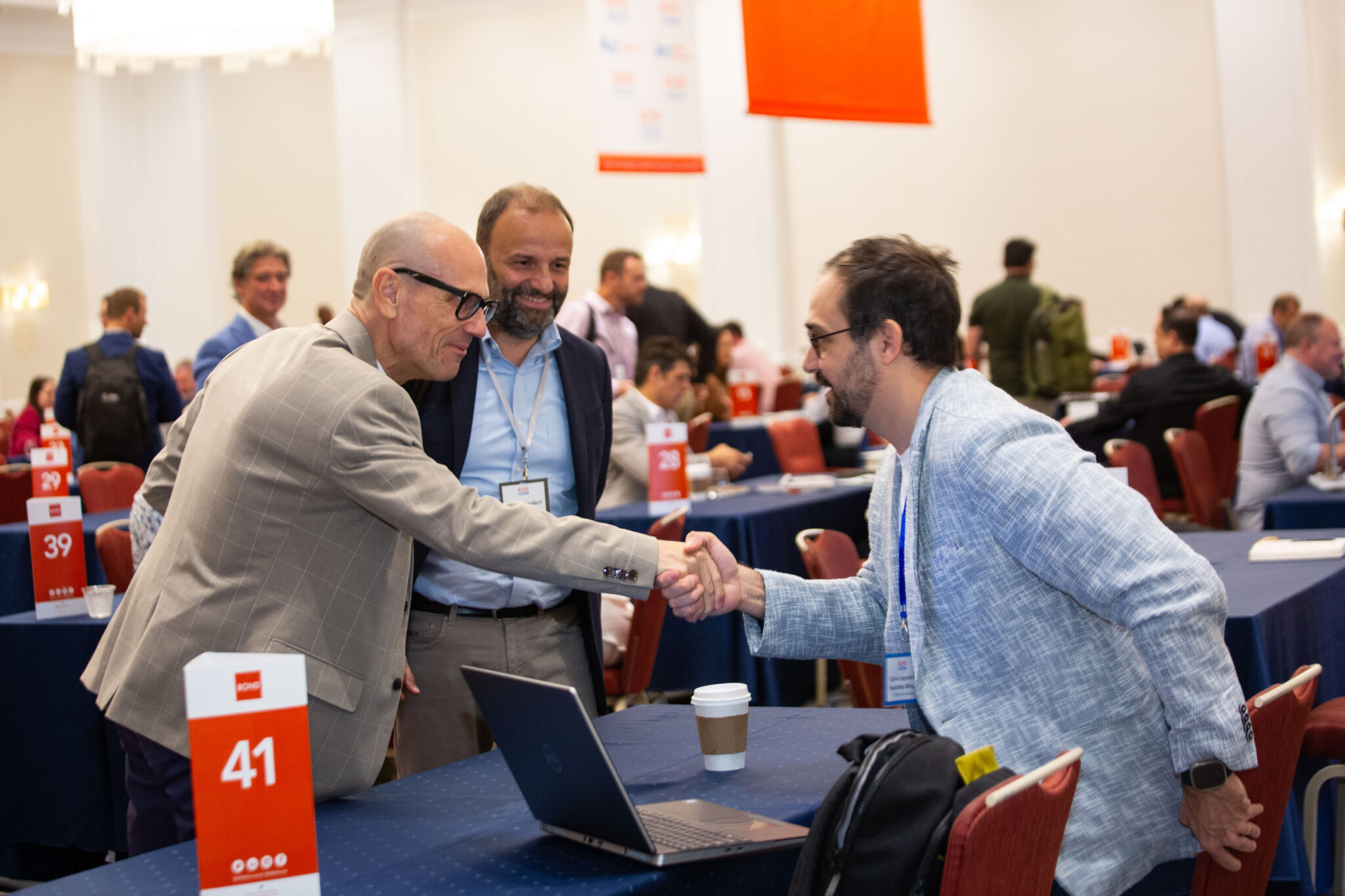
It usually starts with a handshake. And so much can be communicated in those first few seconds: are you minded to listen? Are you genuinely curious to see things from the architect’s side? Do you want to understand their challenges better? Can you make their job (and life) easier and more fun? Are you confident in your product and in your team? It’s amazing what can be conveyed in those first few moments.
Be curious!
In BOND’s 21 years of bringing architects and designers together with building and interior product manufacturers, the golden nugget of advice we are happy to share with any one of those manufacturers is to be genuinely curious about the person you are meeting. To turn up prepared, with faith in your product and in your team and to make it your personal mission to understand things better from the architect’s side and to wait patiently for your cue before attempting to come in with any solutions. Because, if an architect feels heard and understood, they are more likely to open up and respond as helpfully in return.
If you can hold off from launching into your sales pitch and, instead, begin a conversation with the foundations of mutual understanding and a sense of pulling together towards the same goal, that magic thing called trust will start to build and that's what all meaningful business relationship are built on.
"I had a great experience at BOND. I was able to connect with architects from all over the country and gain valuable insight into their opinions and struggles relevant to our industry. On top of that, I was able to share our solutions to some of these struggles, and bring home questions so we can begin a search for answers."
Brennan Boyle, Mainstream Engineering, Director of Commercial Sales and Marketing
Relationships are King
It should come as no surprise that relationships are your ultimate destination when it comes to getting specified by reputable architects for large-scale, high-profile projects: you are probably very aware that project business is, always has been and probably always will be a relationship business but you will also know that getting to that initial handshake can be a long and winding road.
Getting a consistent message across at all your sales and marketing touchpoints (including you) will eventually bring some fresh life into your sales pipeline but getting yourself in front of the true project influencers at the major firms is the game-changer. And this is what BOND can help you to do more than any other channel of selling to architects that we are aware of.
“If there was just one event I could do to keep relevant and keep in front of today’s decision makers in the design community, it would be with BOND Events”
Dean Moilanen, Director of Architectural Services, Noble Group
Build credibility and trust
Consistently delivering the support and information that an architect needs when and where they need it will build your credibility and reputation as a reliable, go-to technical expert in your market and the world will hear about it.
Help just one influential architect in their quest to make better, more informed decisions for their clients and others will soon be knocking on your door.
Unprecedented access to the world's leading architects and designers
BOND guarantees both the number and quality of the architects and designers you will meet at any one of its architect and designer networking events. What trade show gives you that? It’s one of many things that make BOND unique in the architecture and design event space.
Every single architect or designer you will meet at a BOND event must:
- Be at Principal/Practice Leader level or above with real influence to make and protect specification choices
- Work nationally in scope
- Evidence a portfolio of live, confirmed, large-scale projects
This is how BOND delivers an outstanding event experience and the best potential long-term ROI in the business.
Not only do you know exactly who will be at a BOND event before you arrive, you get a guaranteed number of 1-on-1 meetings with your best prospects to kick things off.
With three whole days and nights of quality, relaxed networking around a curated program of events, you can get to know folks on a personal level and this is what opens doors at the big A&D firms.
"BOND is one of the most efficient uses of my time for finding and gathering information on products, materials, and processes. This is the one conference I never miss".
Rodney Kazenske, Owner/Architect, Yardstick Studio LLC
Get specified!

In a relationship business, BOND gives you quality time with the architects and designers who call the shots on the large-scale projects in your sector. Turn up with faith in your product and a genuine curiosity in the person in front of you and your quest to get specified by the world's leading architects and designers will get off to the best start possible.
